Health and Safety Policy for Flat Clearance Honor Oak
This policy sets out the commitment of our clearance business to maintain safe working conditions during every
flat clearance and rubbish removal assignment. The aim is to protect staff, clients, contractors and members of the public by preventing injury, ill-health and property damage while delivering an efficient flat clearance service. It applies to all activities associated with domestic and small commercial flat removals, including pre-clearance surveys, manual handling, hazardous item identification and transportation. The policy uses a risk-based approach and reflects
current best practice in waste handling and rubbish clearance operations.
Scope and Responsibilities
Management will ensure that resources are available to implement and maintain this H&S policy. Every worker and subcontractor engaged in clearance, junk removal or skip-free rubbish collection must follow safe systems of work and report hazards promptly. Supervisors are responsible for ensuring task briefings and that equipment is fit for purpose. The policy covers vehicle loading, stairway operations, communal corridor work, and safe disposal processes. Our objectives include reducing manual handling injuries, minimizing contact with hazardous materials and ensuring all waste is segregated for reuse, recycling or lawful disposal.
Key Duties
Duties are set out below and will be reviewed regularly. Staff and managers share responsibility for maintaining safety standards and for continuous improvement through the safety culture. Core duties include:
- Conducting pre-job risk assessments and documenting control measures;
- Using correct manual handling techniques and mechanical aids where necessary;
- Identifying and isolating hazardous waste (e.g., asbestos suspect materials, sharps, solvents);
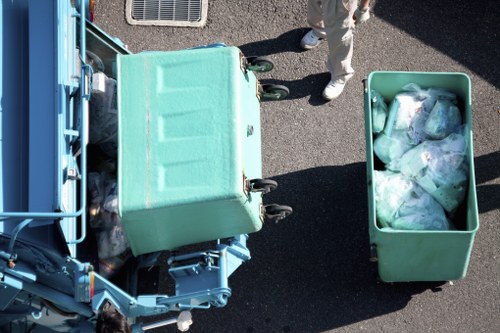
- Ensuring vehicles are correctly loaded and waste is properly restrained;
- Maintaining clear communication and signage when working in communal areas.
Risk Assessment and Control Measures
A formal risk assessment process is applied to all flat clearance projects. Risks are evaluated for likelihood and severity and controls are applied in a hierarchy: eliminate, substitute, engineer, administrate and use PPE. Where feasible, bulky items are removed via windows or balconies using appropriate lifting frames or specialist contractors to avoid risky stairway manoeuvres. Mechanical lifting aids, trolleys and
secure straps are provided to reduce exposure to manual handling. Traffic and pedestrian management plans are prepared for any works affecting shared access.

Safe Systems and Operations
The flat clearance team will follow documented safe systems of work. These include permit-to-work for confined access, clear labelling of containers, and segregation of recyclable materials from general rubbish. Training is provided in manual handling, hazardous materials awareness, fire safety and vehicle loading. Personal protective equipment such as gloves, hi-vis, safety boots and eye protection are issued and must be worn where required.
Supervisors must confirm competency before staff undertake unsupervised tasks, and all unusual loads or suspect waste are escalated for specialist handling.
Training, Competence and Communication
Staff competence is maintained through regular, documented training sessions and toolbox talks. New employees receive induction that covers the policy, emergency procedures, and safe use of equipment. Communication channels ensure that risk information, near-miss reports and changes to procedures are cascaded promptly. The company promotes a culture where employees are encouraged to speak up about risks without fear of reprisal, and where continuous improvement is supported by routine feedback and safety performance reviews.
Waste Management and Environmental Controls
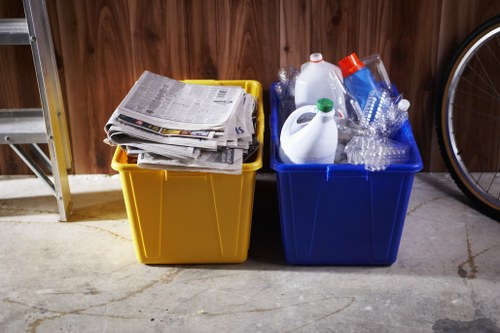
Waste handling is performed in accordance with legal waste duty of care principles and good housekeeping. Items suitable for reuse or recycling are segregated at source to reduce landfill dependency. Hazardous materials are identified and managed using approved carriers and disposal routes. Vehicles are fitted with containment materials to prevent spillage during transport, and appropriate documentation accompanies any hazardous load. The company seeks to minimize environmental impact while complying with regulatory expectations for rubbish clearance and disposal.
Reporting, Incidents and Monitoring
All incidents, near-misses and potential non-conformances must be reported and recorded promptly. Investigations identify root causes and corrective actions are implemented to prevent recurrence. Regular inspections and audits monitor compliance with this policy and the effectiveness of control measures. Performance indicators include incident rates, training completion levels, and audit findings. Senior management will review these indicators and ensure the health and safety policy remains aligned with operational needs.
Policy Review and Commitment
This policy is endorsed by senior management and is reviewed at least annually or sooner if significant changes occur in operations, legislation, or incidents. The company commits to providing sufficient resources to maintain a safe working environment for all flat clearance and rubbish removal activities. Staff are expected to cooperate with safety arrangements and to participate in training and risk control measures.
The overall goal is to deliver a professional clearance service that protects health, prevents harm, and meets legal and ethical responsibilities. Through continuous assessment and staff engagement the organisation will strive to reduce risks associated with clearance work and to improve safety outcomes for everyone involved.